Ten Years of The Message: The Alumni Who Came Home for One Night

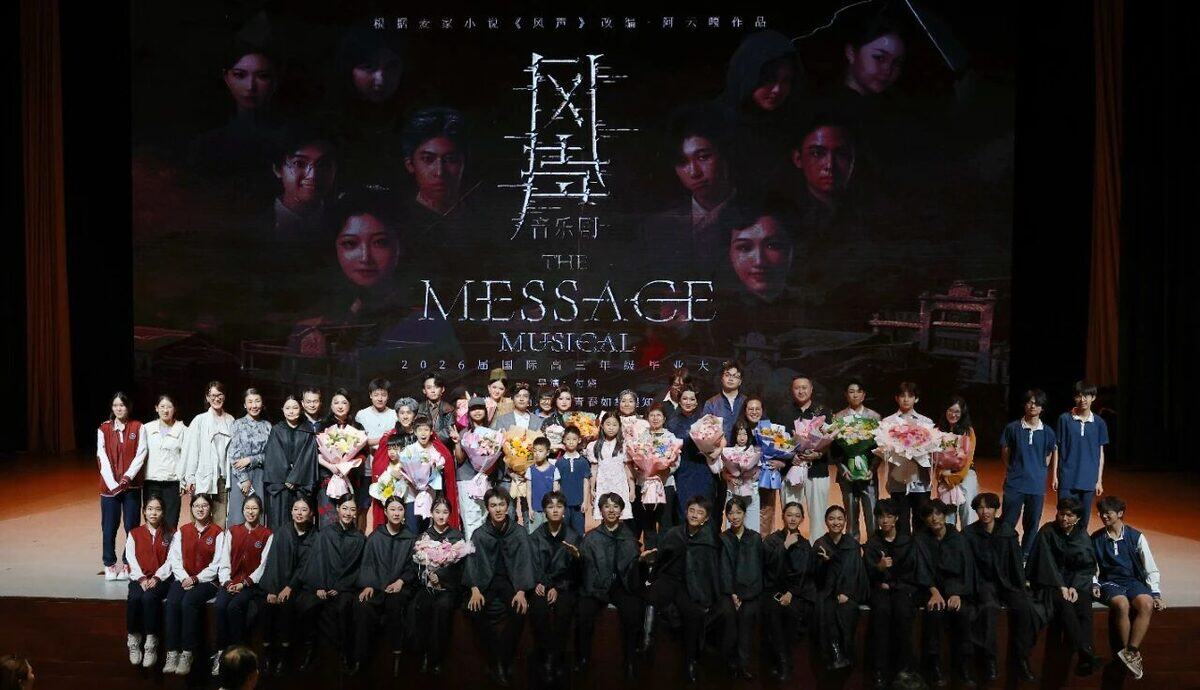
The house lights went down at seven, and a single beam found a table, two chairs and the shadow of a staircase. For three seconds the audience at the Jingbei campus theatre could hear the ventilation. Then the strings came in, and the date on the backdrop read 1941.
The production was The Message, the musical adapted from Mai Jia’s novel of wartime espionage, and the occasion was the tenth anniversary of the graduation play — the annual production the international senior class stages in its final spring. The theatre was full on 26 May, and in the reserved rows sat alumni from the nine earlier casts, some of whom had flown in from Europe and North America for the evening.
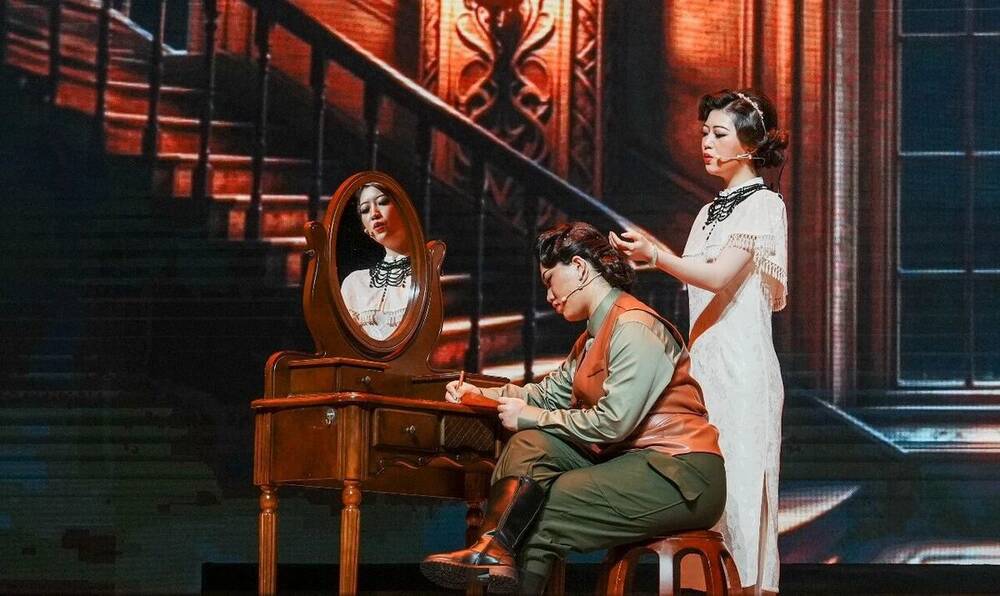
The plot turns on two women in a requisitioned manor: Gu Xiaomeng, who plays every side, and Li Ningyu, who plays none. One of them is the mole the Japanese commander is hunting. The interrogation scenes are the spine of the show — two actors at a table, a lamp between them, and the audience leaning forward to catch which of them blinks first.
“For a tenth anniversary you need a piece with weight,” said the director, Fu Rao. “Ten years of this programme has been about sincerity and holding on to something. The Message is about faith, courage and a loyalty bigger than yourself. That is the same lesson, in a different key.”
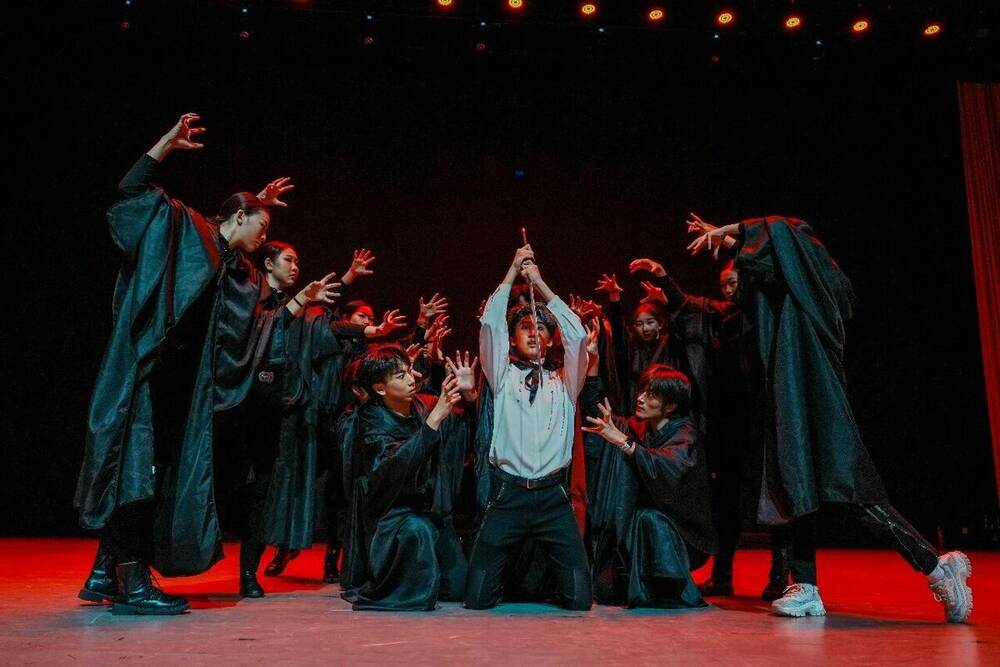
The staging is spare and deliberately cold: grey walls, a single staircase, the click of a cipher machine used as percussion. In the code-courier sequence a dozen performers in black cloaks move through the dark without speaking, passing messages hand to hand in a silent relay that lasts almost four minutes. None of them are graduating seniors. They are members of the middle school drama club who volunteered for the anniversary production and gave up their evenings to rehearse.
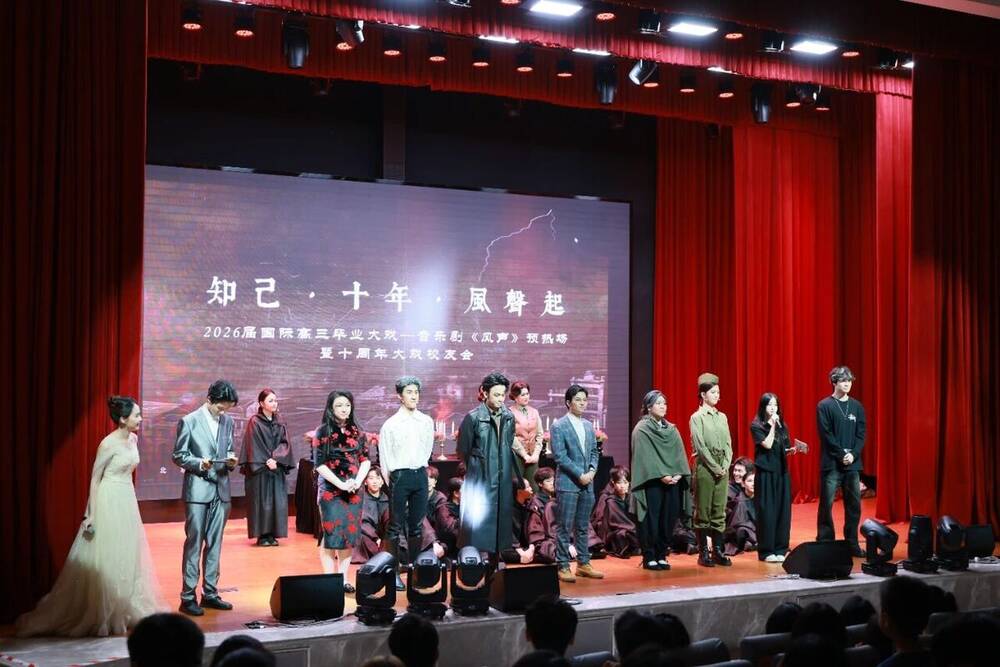
Between scenes, the school turned the evening into a reunion. Song Jianhua, vice principal, walked to the front of the stage and looked along the rows of familiar faces. “However far you go, the door of this school stays open,” he said. “The children who played those roles are sitting among us tonight.” The line got the biggest laugh of the night, and then the longest applause.
Wang Guanlin, class of 2018, came back eight years after playing Lao Tao in Secret Love in Peach Blossom Land. He remembered the props: three chairs and a banner. In the scene where the boat capsizes, he fell, the chairs went over, and the banner wrapped around his head. The audience roared. Afterwards his drama teacher told him, evenly, that they had laughed because he had not been truthful enough.
“I have run a company since then, and I have capsized a few times,” he told the students. “Every time I wanted to stop, I remembered that sentence. The conditions can be cheap. The work cannot be.”
The returning casts were handed gifts keyed to their own productions: replica rifles for the Taking Tiger Mountain by Strategy cohort, a deck of cards for Lucky Stiff with a card for every character and both jokers reserved for the boy who played the shark, the cast recording for the Q Avenue veterans, and posters signed by the leads of Charlotte’s Troubles.
No one had a longer view of the programme than Jiang Junyu, who has appeared in four of the ten productions. He played Gao Xiaochen in The Knockout, the shark in Lucky Stiff, Zui Hua in Taking Tiger Mountain and Bai Xiaonian in The Message. This spring he also collected offers from Hong Kong Baptist University and the Nanyang Academy of Fine Arts in Singapore, and handed over the presidency of the drama club.
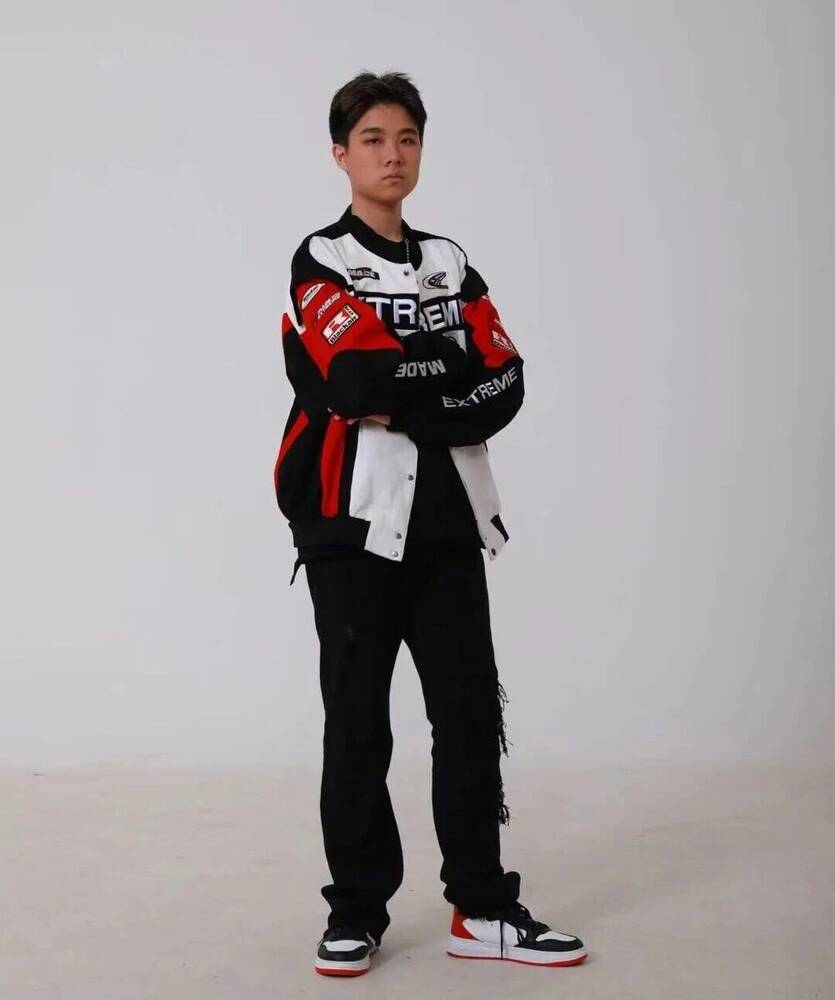
“People ask why I got four years when everyone else gets one,” he said. “Because I loved it, and because that love was seen and protected.” He had wanted a lead for his final year, and learned early that The Message is a two-hander for two women. “I lowered my expectations, and then I stopped auditioning for the biggest part and started auditioning for the best one.”
His classmate Qiao Sirui, who plays Li Ningyu, was cast against the room’s first instinct. “The director chose me and then defended the choice,” she said. “I was told my eyes were empty. So I learned to act with details — a trembling eyelash, a finger turning a button. The drama studio became the most solid, happiest place I know.”
Wang Wei, who plays the Japanese commander, resisted the role at first. “I was used to standing in the brightest part of the light,” she said. “Then I watched the same line rehearsed fifteen times and nobody complained except me. There are no small roles. There is only the size of what you are willing to give.”
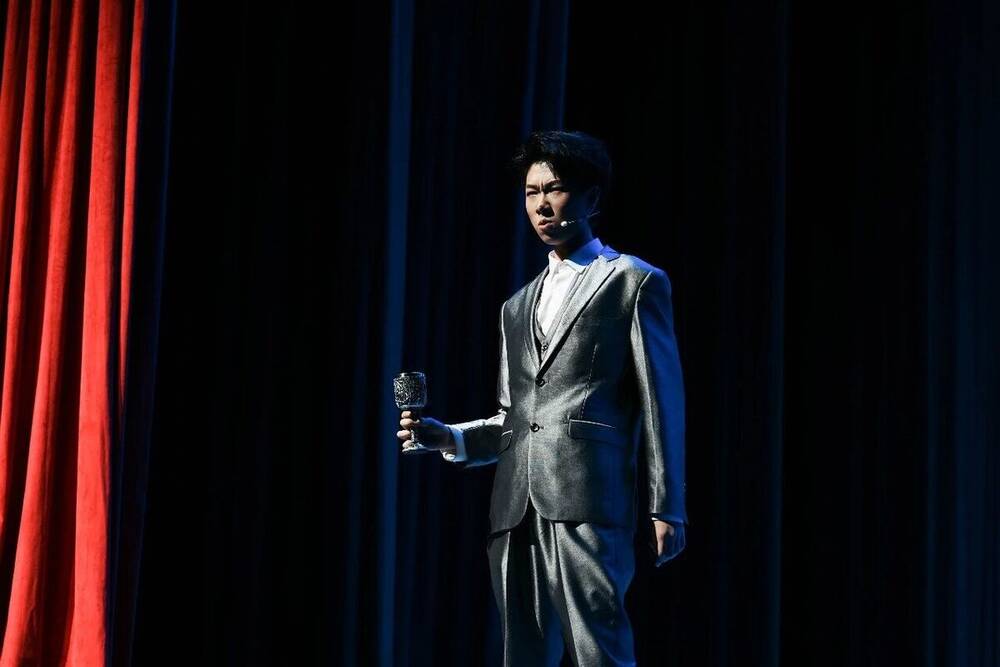
The last number was Zhi Ji — “the one who knows me” — sung by the whole company, hands linked. The audience hummed the chorus back at them. The actress playing Li Ningyu, still in costume, said her curtain speech with a cracked voice: she had been afraid of ruining the tenth anniversary, and the school had held her up anyway.
Ten years ago the graduation play began with a handful of teachers and a borrowed idea. It is now an annual fixture that involves several hundred students, alumni and staff, and the most anticipated night of the commencement season. The lights came up at the end. For a while nobody in the theatre moved.